Review of MCAT Free Full-Length Sample Test
Chemical and Physical Foundations of Biological Systems
Missed Questions
Question 2
Subcategory: Molecular configurations
Key concept: The number of stereoisomers for a compound with n chiral centers is equal to 2^n possible stereoisomers.
Question 3
Subcategory: Bioenergetics
Key concept: A precipitation reaction occurs when dissolved substances react to form a solid product. The solid will form when the reaction quotient, Q, exceeds the equilibrium constant Ksp. Q= Product of concentrations of reactants
Question 5
Subcategory: Electricity and magnetism
Key concept: Electric fields by definition start on a positive charge. They point towards negative charges. Electric field around axons
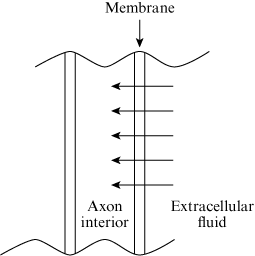
In the body, axons rest at a negative potential, while the surrounding fluid is neutral.
Question 20
Subcategory: Bioenergetics
Key concept: The Michaelis-Menten equation governs reaction velocity in enzymatic reactions. V0 = (Vmax x S) / (Km + S) V0 = reaction velocity, Vmax = maximum reaction velocity, S = substrate concentration, Km = Michaelis constant
The Lineweaver Burk plot is a way to represent a Michaelis-Menten governed reaction. In the Lineweaver Burk plot, the x-axis is 1/S, and y-axis is 1/V0. The slope is thus S/V0, and the y-intercept is Vm.

Question 23
Subcategory: Gas laws
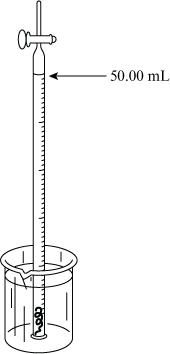
Key concept: In this situation, the air pressure inside the tube is lower than the air pressure outside the tube. Hence, the water level is higher inside the tube.
Question 27
Subcategory: Light and sound
Key concept: An ultrasound uses the Doppler effect. To image the motion of the body, it requires the speed of the sound, and the frequencies of the sound waves emitted and observed by the transducer.
Question 29
Subcategory: Atomic structure
Key concept: The principal quantum number n describes the energy of an electron in that shell, and the most probable distance of that electron from the nucleus.
Example: if n = 7, what is the principal electron shell?
Answer: 2
Question 30
Subcategory: Biochemical trends
Key concept: The binding constant Ka is positively correlated with the binding reaction of receptor and ligand molecules.
Ka is in inverse concentration units. The inverse of Ka is the disassociation constant Kd, which has units of concentration.